
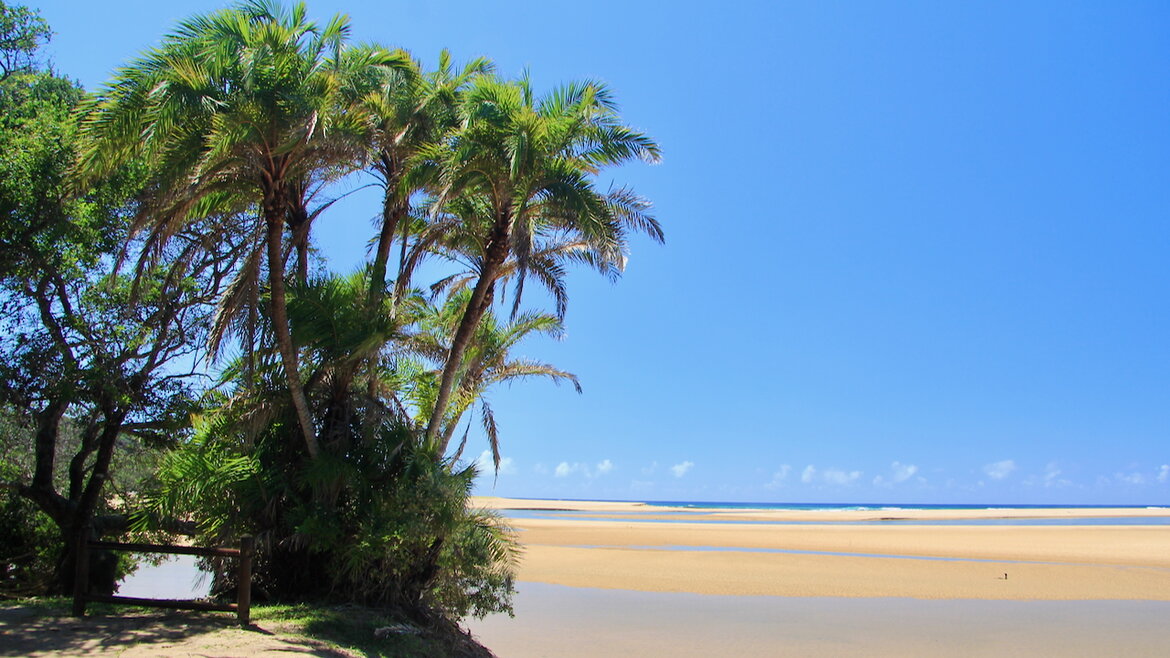
Warm water curls around my ankles in the shallows at Kosi Bay Mouth as a silver shoal of tiny fish twists past my feet. It’s the kind of moment that makes me think, ‘Why have we never been here before?’
For years, we’ve rushed past Kosi Bay on our way to scuba dive in Ponto d’Ouro, windows down and dive gear packed, always promising we’d stop ‘next time.’ Now, finally standing still in the shallows, I feel those passing years slip away with the outgoing tide.
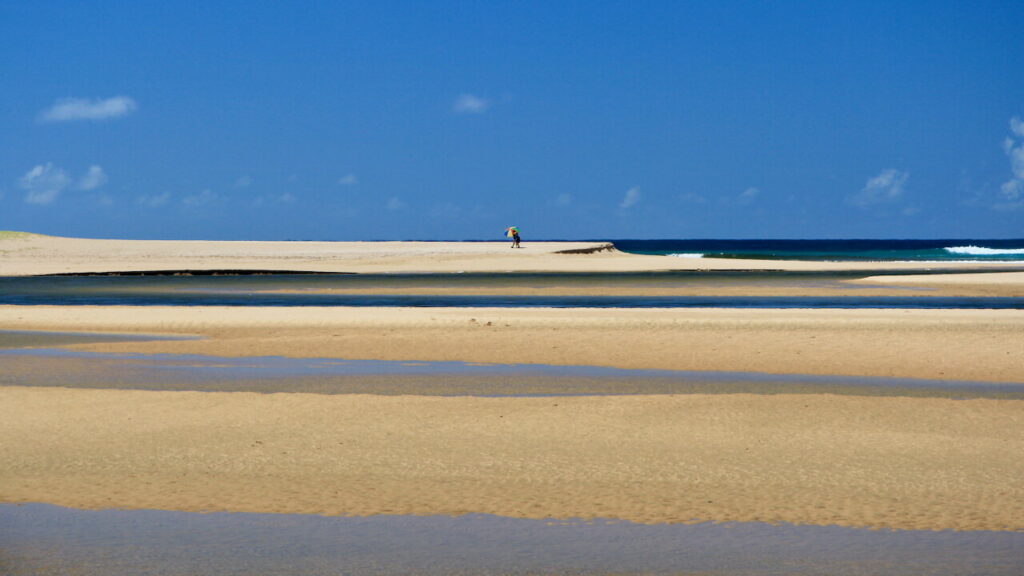
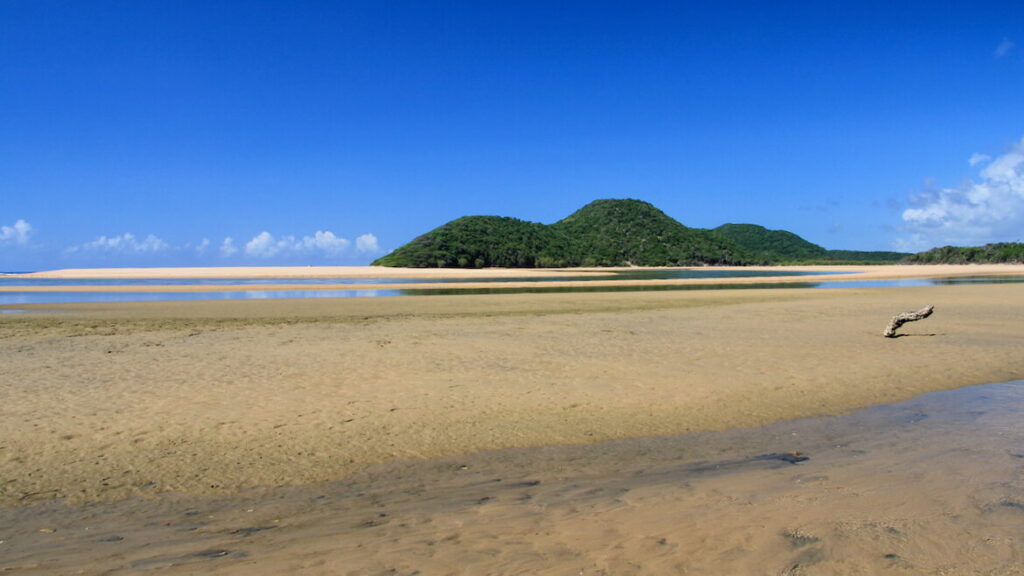
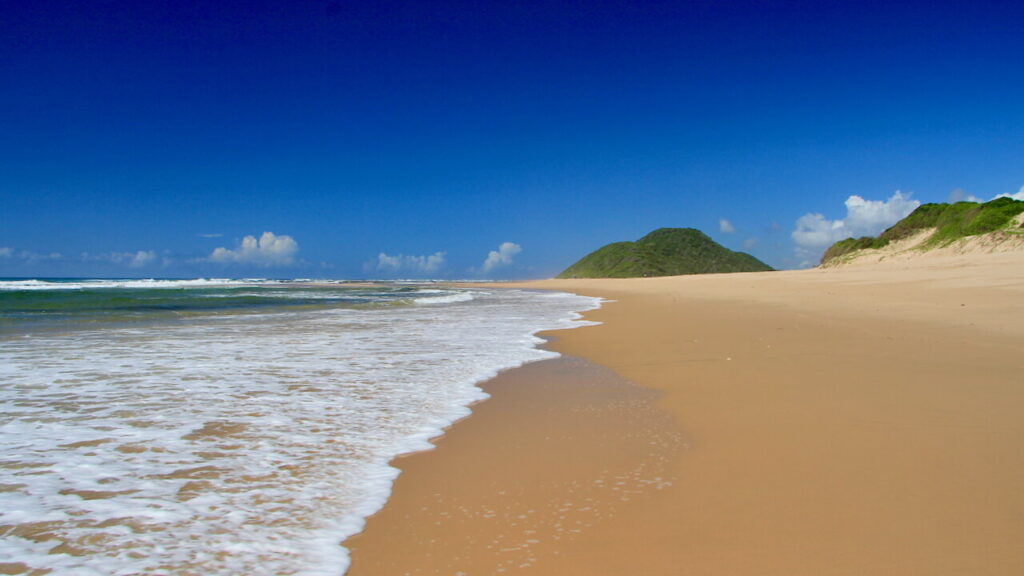
Golden sand runs to the horizon, where white-tipped waves fringe an azure ocean. At my feet, a glassy ribbon of turquoise threads through the sand from the lakes to the sea. Sunlight glazes its surface with silver, and the gentle pull of the current tugs at my ankles. Time seems to loosen here. The sky feels wider, colours deepen, and the air softens.
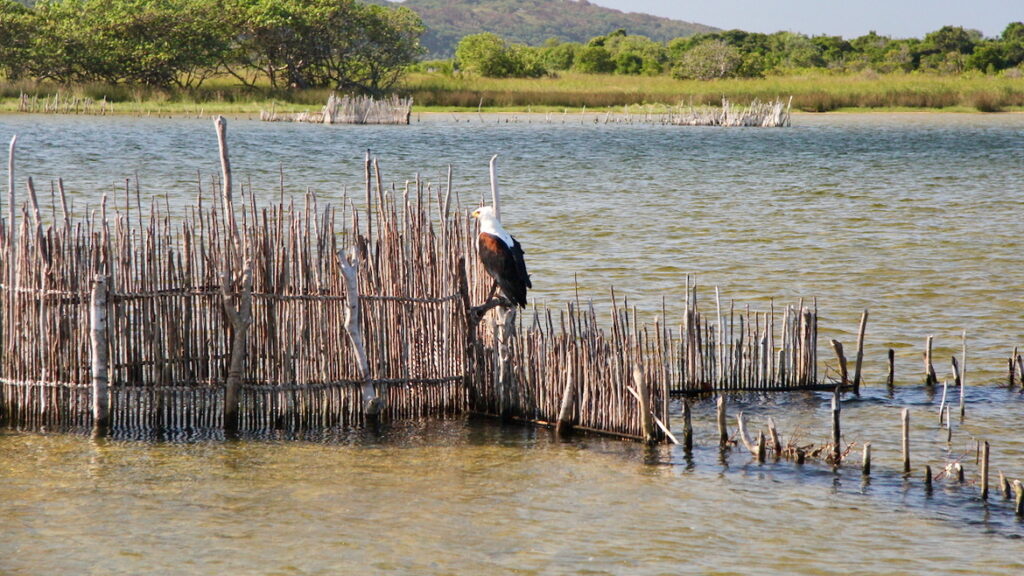
Wader birds comb the shallows, fish flicker over rippled sand, and somewhere in the distance, a fish eagle calls, its cry carrying across water and dunes.
But before I tell you more, where exactly is this wild place?
Where is Kosi Bay?
Kosi Bay sits pressed up against the border with Mozambique, right at the top east corner of South Africa’s KwaZulu-Natal. It’s the kind of place you reach where the neat edge of the tar road frays into sand tracks and your phone signal flickers, sighs, and then simply gives up.
It’s not really a town, not just a bay either, but a whole watery world: a system of four lakes linked together by reed-lined channels that empties into the Indian Ocean at Kosi Bay Mouth. On paper, that sounds straightforward. In reality, it feels like someone spilt a box of blues and greens and forgot to tidy up.
Kosi Bay is the northernmost corner of the iSimangaliso Wetland Park, a UNESCO World Heritage Site – a mouthful of a title for a place that, in person, feels more like a long exhale. The kind you don’t realise you’ve been holding until you get here.
It is remote, raw and wonderfully unpolished. Kosi Bay feels like a piece of an older Africa that somehow slipped through the cracks of modern life.
Timekeepers of the Tides: The Thonga Fish Traps
As lyrical as the landscape is, Kosi Bay isn’t just about wild beauty. It’s also a place where people and water have been in conversation for centuries.
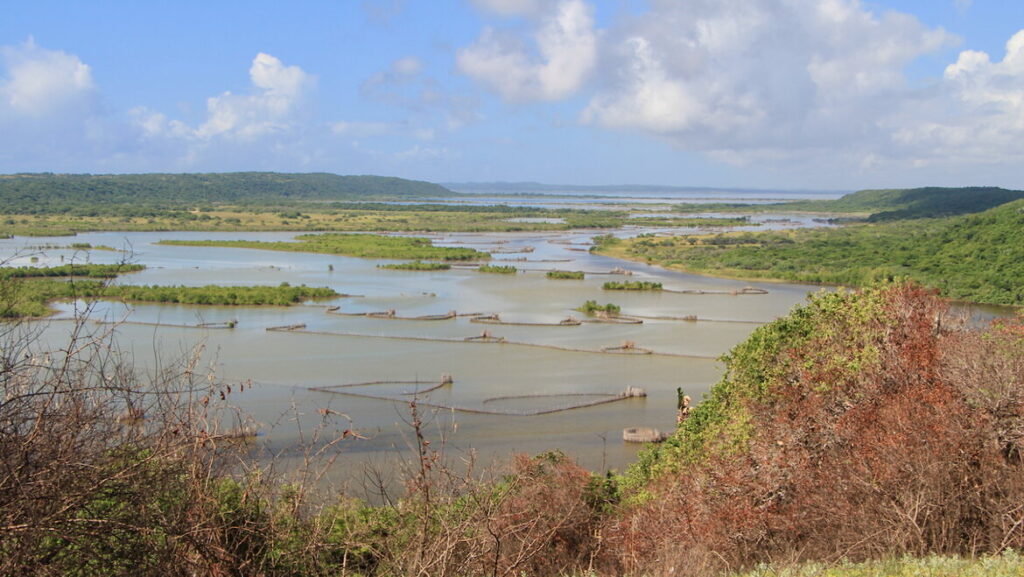
Throughout the lake system, the traditional Thonga fish traps rise from the shallows like delicate, geometric sketches drawn into the water’s surface. Each trap is carefully constructed from wooden stakes and reeds, forming intricate, maze‑like enclosures.
Built in harmony with the tides, these traps guide fish along natural pathways, allowing the Thonga people to harvest the sea’s bounty in a way that’s both sustainable and deeply rooted in tradition. The knowledge of how to build and tend them has been passed down from generation to generation for over 600 years in an unbroken thread linking present-day Kosi Bay to its past.
It’s humbling to realise that while we come and go with our cameras and itineraries, these quiet wooden lines have stood in Kosi Bay long before us and will hopefully remain long after.
Kosi Bay Mouth: A Threshold Between Worlds
All that water, all those lakes, all that quiet inland world — eventually, it all flows towards one place, Kosi Bay Mouth.
It’s mid-morning when we venture out to see Kosi Bay Mouth for the first time. Being told we needed a 4×4 felt a little dramatic until we crossed a wooden bridge. Suddenly, we’re driving right on the edge of one of the lakes, our tyres almost kissing the water’s edge.
This would have been the moment to consider the tides.
Naturally, we don’t.
About two kilometres from the bridge, we meet a park worker who shows us where to park. When we ask how far the beach is, he replies, ‘Not far, about two to ten minute walk!’
Puzzled, but amused, we decide to take a quick peek to see what he means. We stroll through a short, shady tunnel of coastal dune forest and step out onto a big reveal: beautiful golden sands, sparkling, clear water, and swaying palm trees. Further out, gentle white foamed waves softly crashing onto the reef that guards the entrance to Kosi Bay Mouth.
Without another thought, we step into the ankle-deep estuary waters. The temperature is perfect, and the sandy bottom glows as if someone has thrown handfuls of light across it.
I feel the faintest pull at my ankles as we follow the channel. Sometimes we wade through knee-deep water, at other times we stroll along the white sands lining its edge, until we reach the ocean.
I stand up after a quick swim, ankle-deep in clarity. The Indian Ocean stretches out ahead, the estuary tucks in behind me, and dunes and forest frame the edge of my vision. I feel as if we’re standing on a threshold between worlds: freshwater and salt, lake and sea, sheltered channels and open horizon.
And then Dave says, ‘I think the tide’s turned! It’s coming in now.’
The journey back becomes less about exploring and more about whether we’ll make it through the water now covering the tracks. We do, a little soggier and a lot more respectful of the tides.
A Place that Refuses to Rush
Kosi Bay Mouth is not the sort of destination you simply tick off a list. It asks you to do something modern life rarely encourages: slow down, pay attention, and let the place seep into you.
Here, fish eagles feed in mirror‑calm shallows. Hippos surface like slow, breathing boulders in the deeper lakes. Ancient fish traps hold their lines against the tides, and clear channels invite you to drift and watch the underworld unfold beneath you.
It’s not polished. It’s not convenient. The roads are sandy, the signal is patchy, and the closest supermarket is a drive away. But in return for a little effort, Kosi Bay Mouth offers something that lingers long after you leave.
Standing at Kosi Mouth in the middle of the day under a saturated blue sky without another soul in sight, I felt very small and very lucky. For a few moments, I’d been allowed to step into a fragment of the world that still remembers how to be wild.
If Kosi Bay Mouth has you dreaming of more wild corners of northern KwaZulu-Natal, Tembe Elephant Park is just up the road – only 61 km from the Mouth. It’s home to some of Africa’s largest tuskers, and one of the few places where you can still feel very small in the presence of truly giant elephants. I wrote about it here: Close Encounters with the Giants of Tembe Elephant Park.
Kosi Bay Mouth: Good to Know
Do you need a 4×4 for Kosi Bay?
Yes. The last stretches of road to Kosi Bay Mouth and many lakeside spots are sandy – often deep sand. A 4×4 or high-clearance vehicle is highly recommended if you want to avoid digging out in the midday heat.
You can park at the wooden bridge and walk ±2 km to the Mouth. It’s a lovely stroll, but in summer the humidity can be brutal, so plan for that.
Tides at Kosi Bay Mouth
If we’d paid attention to the tides, our first visit wouldn’t have ended in a mad dash back to the car and a nail-biting, watery drive along the edge of the estuary.
We learnt that the tides will shape your days at Kosi Bay Mouth. It’s best to visit around low tide for the easiest wading and driving conditions.
Is Kosi Bay A Malaria Area?
This is a malaria risk area. Take sensible precautions by using insect repellent and wearing long sleeves and pants at dawn and dusk. Sleep under a mosquito net if you can. If you can’t, keep doors and windows closed to stop mosquitoes and other critters from wandering in. It’s worth your while to speak to your doctor about prophylactic medication before you go.
And don’t forget the sunscreen – the sun here bites hard, even on a cloudy day.
Can you swim at Kosi Bay Mouth?
Yes, you can swim, but this is wild water, not a swimming pool. Hippos and crocodiles live here, so check with your lodge or guide about where and when it’s safe to swim.
Kosi Bay Conservation fees and litter
At the time of our visit, one thing did bother me. I don’t mind paying a daily conservation fee to enter a park. These fees are important, but in the Kosi Bay area of iSimangaliso, you pay each time you enter a gate.
In a single day, we paid twice:
• Kosi Bay Estuary Gate: R180 for two people and a vehicle
• Main gate to the third lake: R120 when we went on a boat cruise
These fees may have changed since our visit, but it’s worth budgeting for multiple entries if you’re coming and going.
What troubled me more, though, was the sheer amount of litter at the Estuary Lookout. We estimated over 250 bottles and cans. It’s disheartening to see a World Heritage Site treated that way.
Where to stay near Kosi Bay Mouth
We camped at Utshwayelo Kosi Mouth Lodge and Camping, just outside the Kosi Bay Estuary Gate on the edge of iSimangaliso. What I really like is that it’s a community partnership. This means your stay helps support local families rather than a distant owner.
Most of the campsites sit beneath big waterberry trees, which means deep shade, cool afternoons, and wonderful birdlife. We even had an owl in our tree, watching over us at night.
Each site is enclosed by reed walls, giving you that extra sense of privacy we really appreciated. After our fish trap tour, I joked to Dave that the reed enclosures looked like fish traps themselves. Only on our last day did we find out that *utshwayelo* actually means “fish trap” in Tsonga.
If you’re not a camper, you’re not left out. There are self‑catering rustic cabins and luxury permanent tents as well, so you can still wake up to the sounds of the coastal forest. And if you’d rather not cook, the lodge can prepare your meals too. But make sure to book this when you make your reservation.
Things to do in Kosi Bay
The friendly reception staff at Utshwayelo are on hand to arrange a must-do 3 lake boat cruise or a tour of the fish traps. You might prefer a guided hike, a kayak trip, or a birding trip. All of these can be arranged for you with a local guide.
And then there are the turtle tours…
Kosi Bay Turtle Nesting Season (Don’t Miss It, As We Did)
We timed our visit just a few weeks too late for one of Kosi Bay’s most extraordinary rituals: turtle nesting season. From around November to March, the beaches here become an important breeding ground for Loggerhead and Leatherback turtles.
Although we didn’t get to watch these ancient mariners heave themselves up the sand to lay their eggs, just knowing it happens here adds another layer to Kosi Bay Mouth’s magic.
It remains one of those “next time” promises we’ve made to ourselves – as if we needed another reason to return.
DISCLOSURE: I have no commercial relationship with Utshwayelo, iSimangaliso, or any of their affiliates. I have not received any payment, discounts, or other benefits in exchange for this post. All views expressed here are my own and are based solely on my personal experiences in nature. All photographs, descriptions, and opinions are my own work.
2 comments
Jennifer, I’ve loved following your nomad life and the updates on your stories and moments from your travels have been so incredibly interesting and beautifully written and shared.
It honestly feels like I’ve been travelling along with you and Dave from my couch! I’ve learnt so much more about the incredible country we’re lucky enough to call home. Wishing you both a safe journey and cannot wait to see more of your amazing adventures..
I’m so glad you are enjoying my postcards, or maybe that should be letters seeing as they are longer than a postcard, from the road. Thank you for taking the time out to read my stories.